


Contents
1.0 Brick Specifications
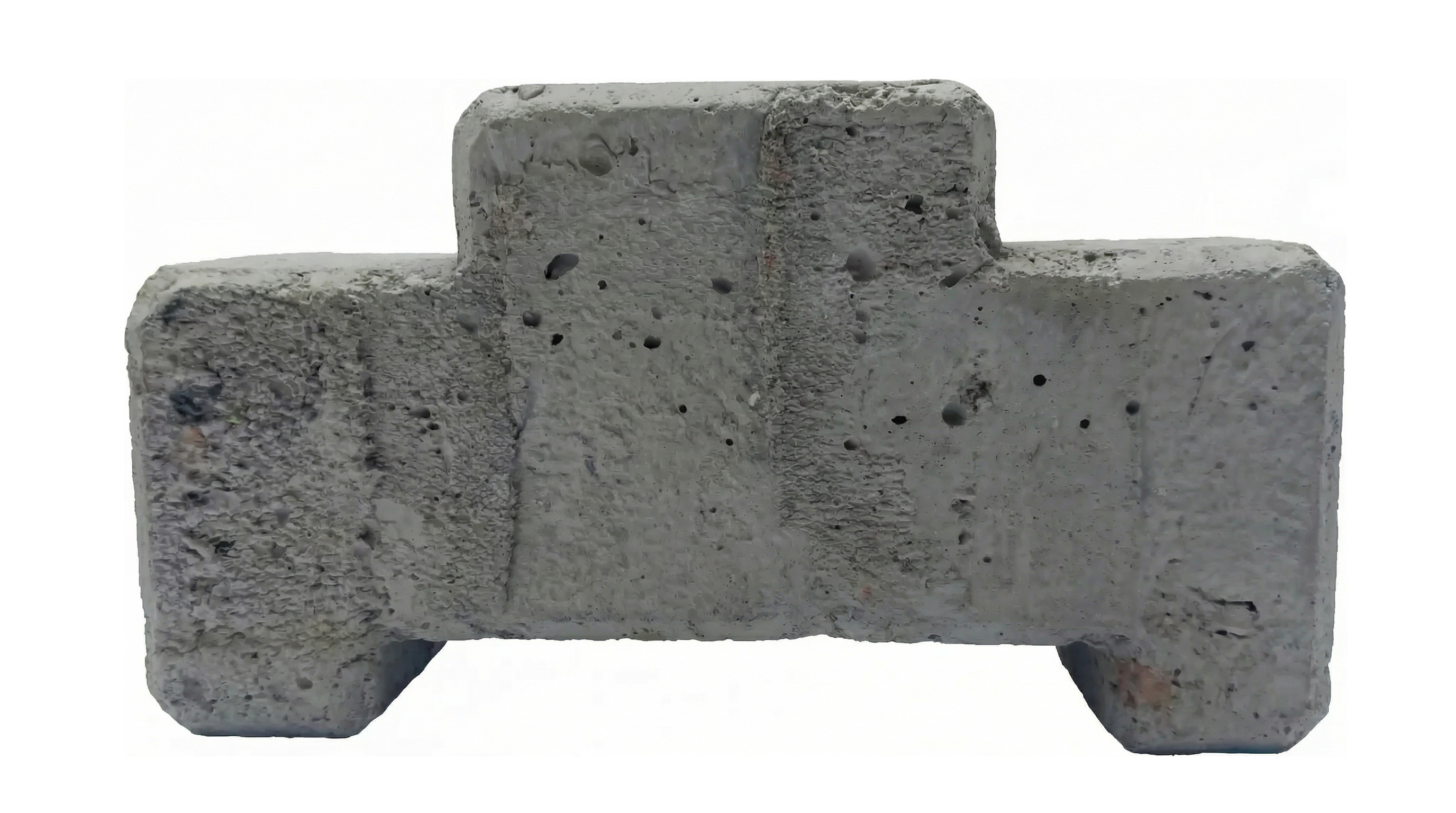
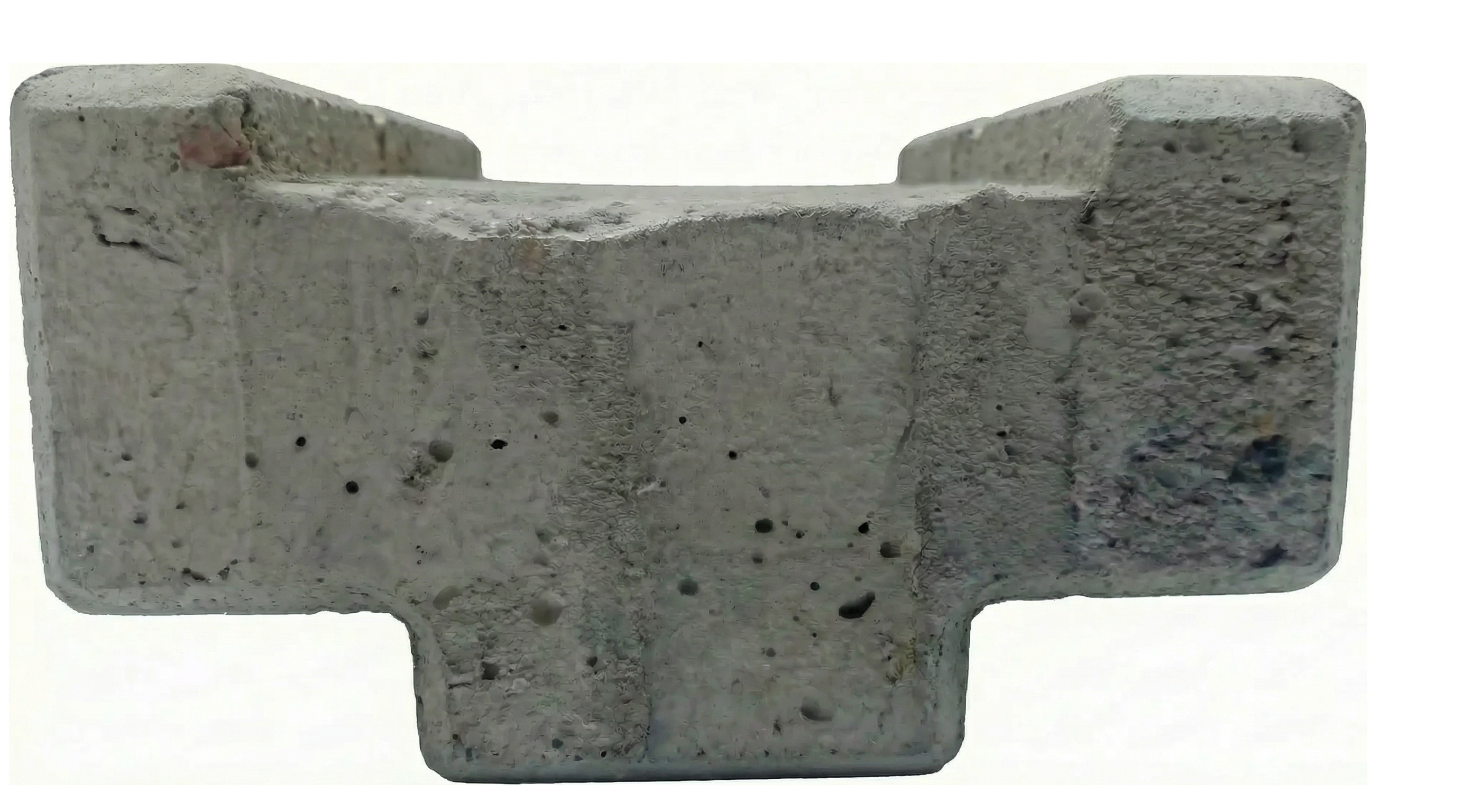
2-Foot Modular
Interlocking Concrete System
Product Specifications
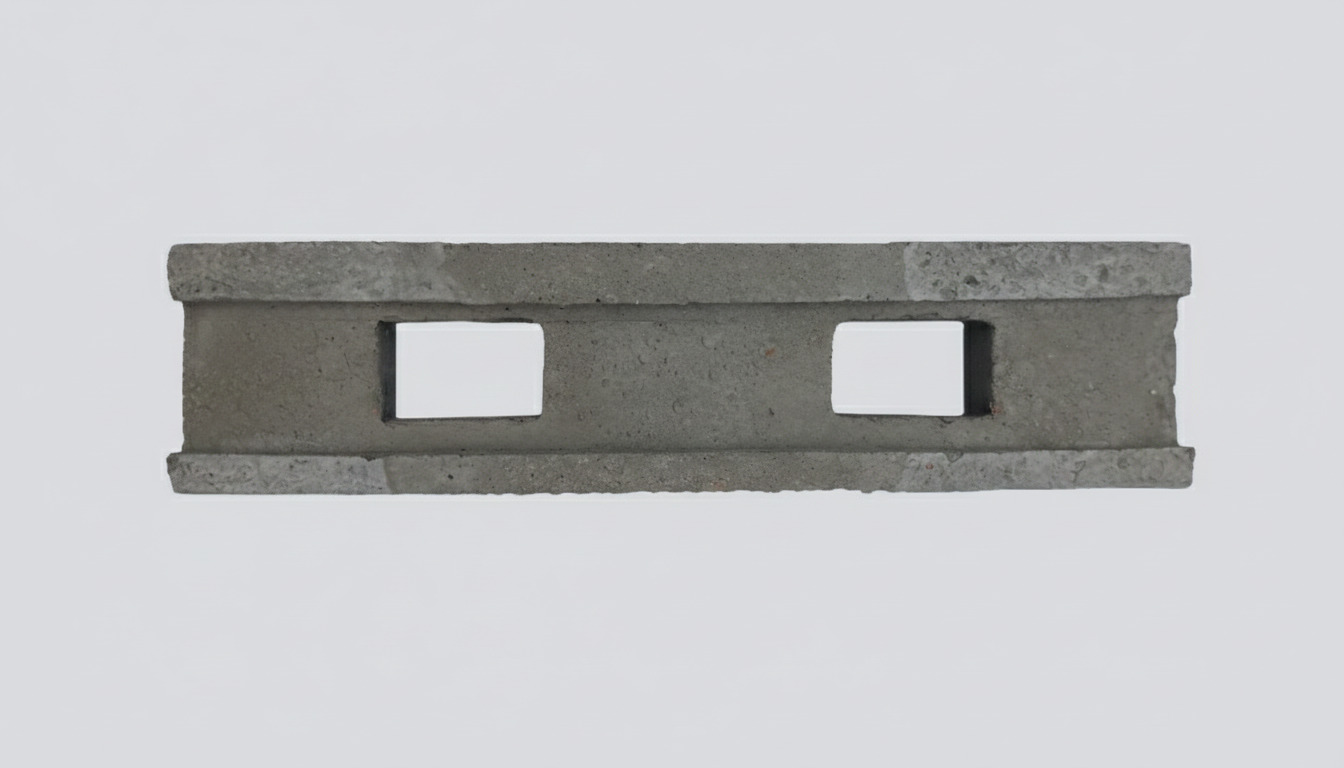
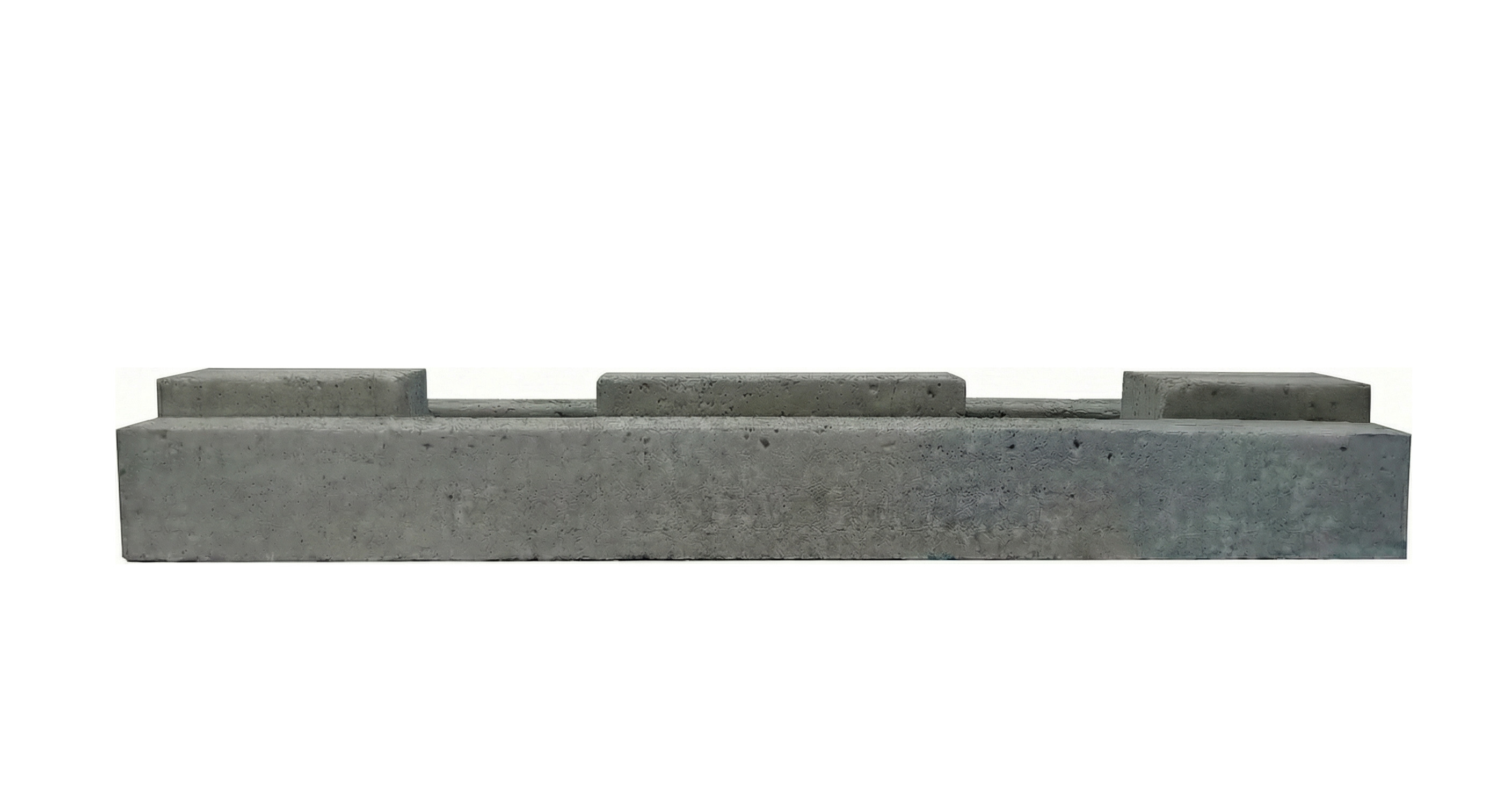
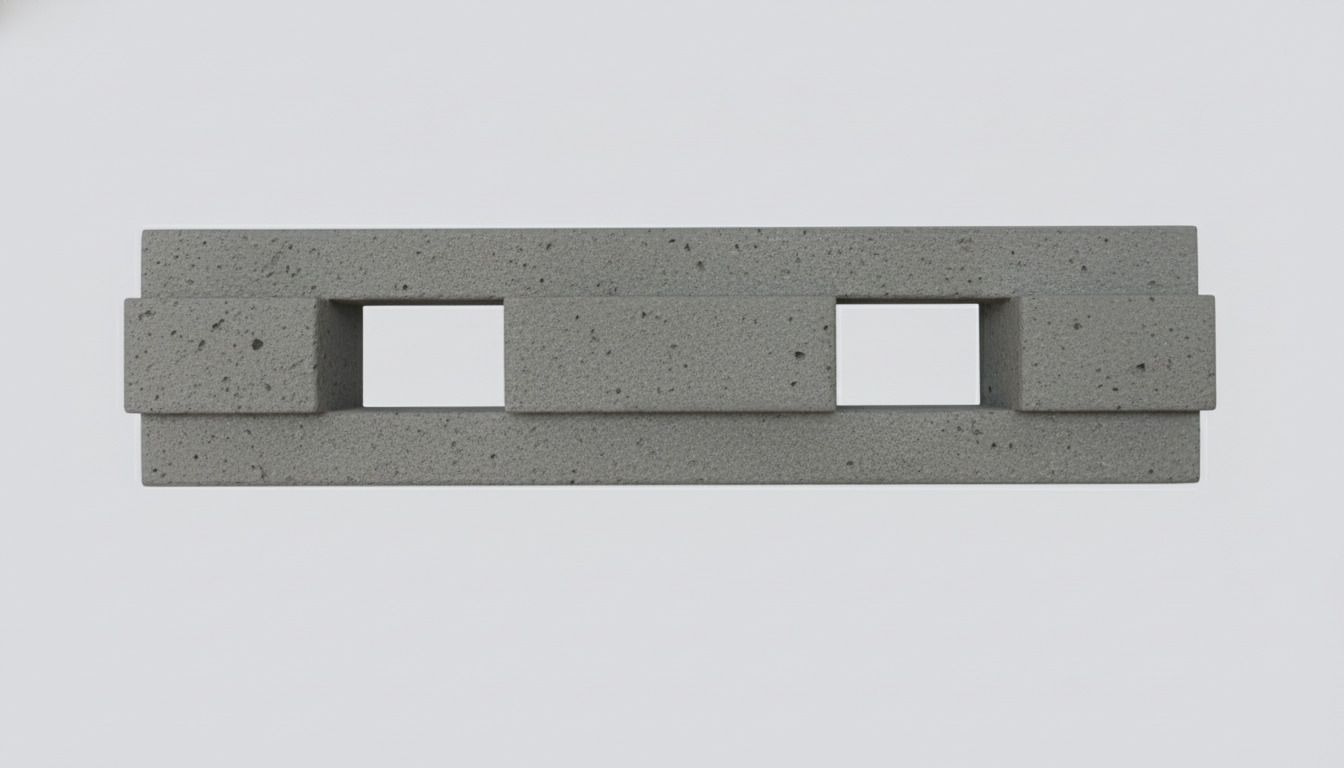
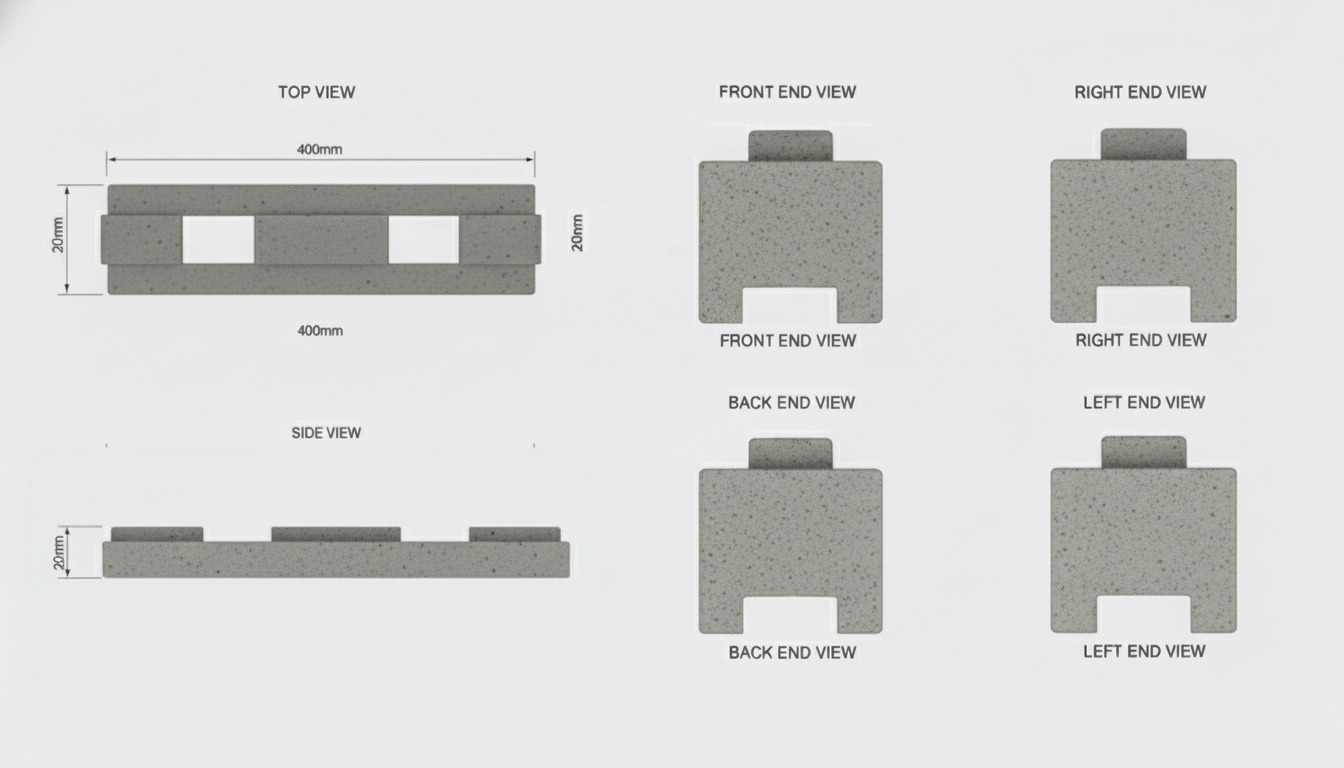
Product Name: Interlocking Modular Concrete Brick
Dimensions: 24 inches (2 feet) length
Material: High-strength concrete (2,000-3,000 PSI)
Finish: Natural rough texture
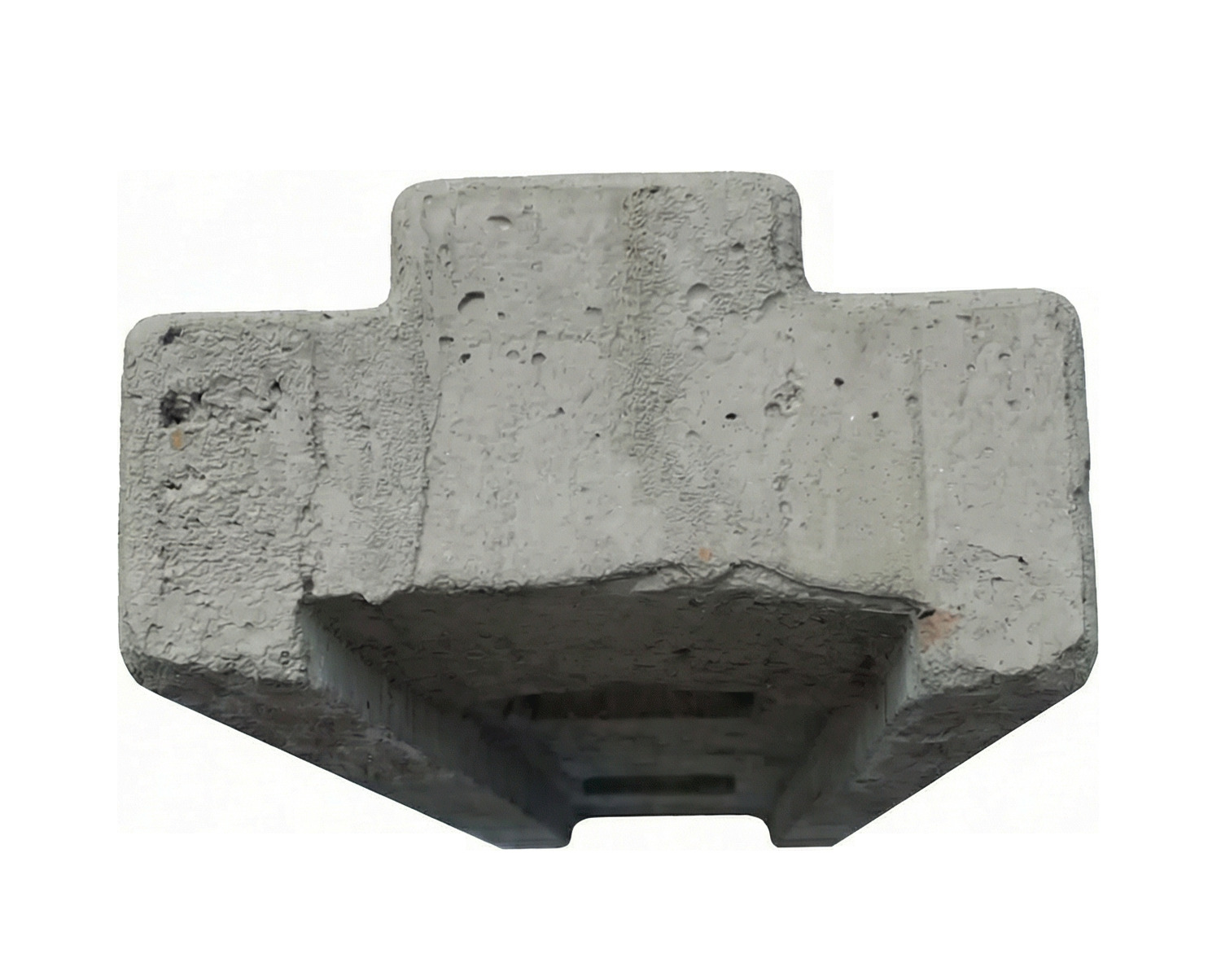
- Secure Connection: Precision-engineered interlocking
- Weight Reduction: Integrated rectangular openings
- Versatile Design: Curved and angled layouts
- Surface Texture: Enhanced friction
- Load-Bearing: Residential construction grade
2.0 Construction Process & Assembly
2.1 Foundation
Site excavation, leveling, soil testing. Reinforced concrete slab/strip footing required with 4-6″ gravel base. Must be perfectly level.
2.2 Brick Assembly
Align protrusions with grooves. Slide horizontally or stack vertically. Use running bond (12″ offset) and alternate corners.
2.3 Tools
Spirit level, rubber mallet, chalk line, string line, masonry saw, safety gear. Materials: Bricks, adhesive, rebar.
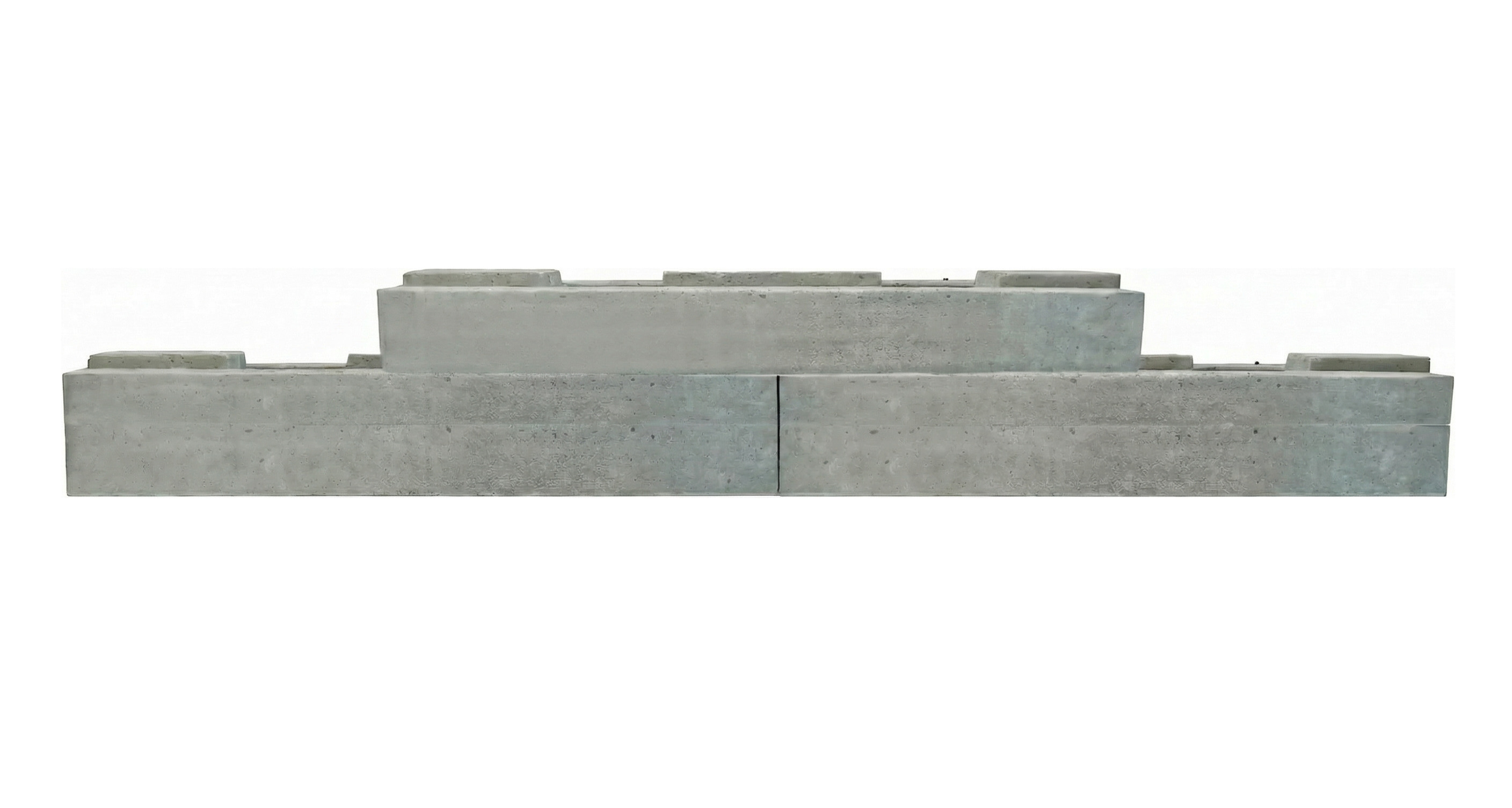
Assembly Methodology
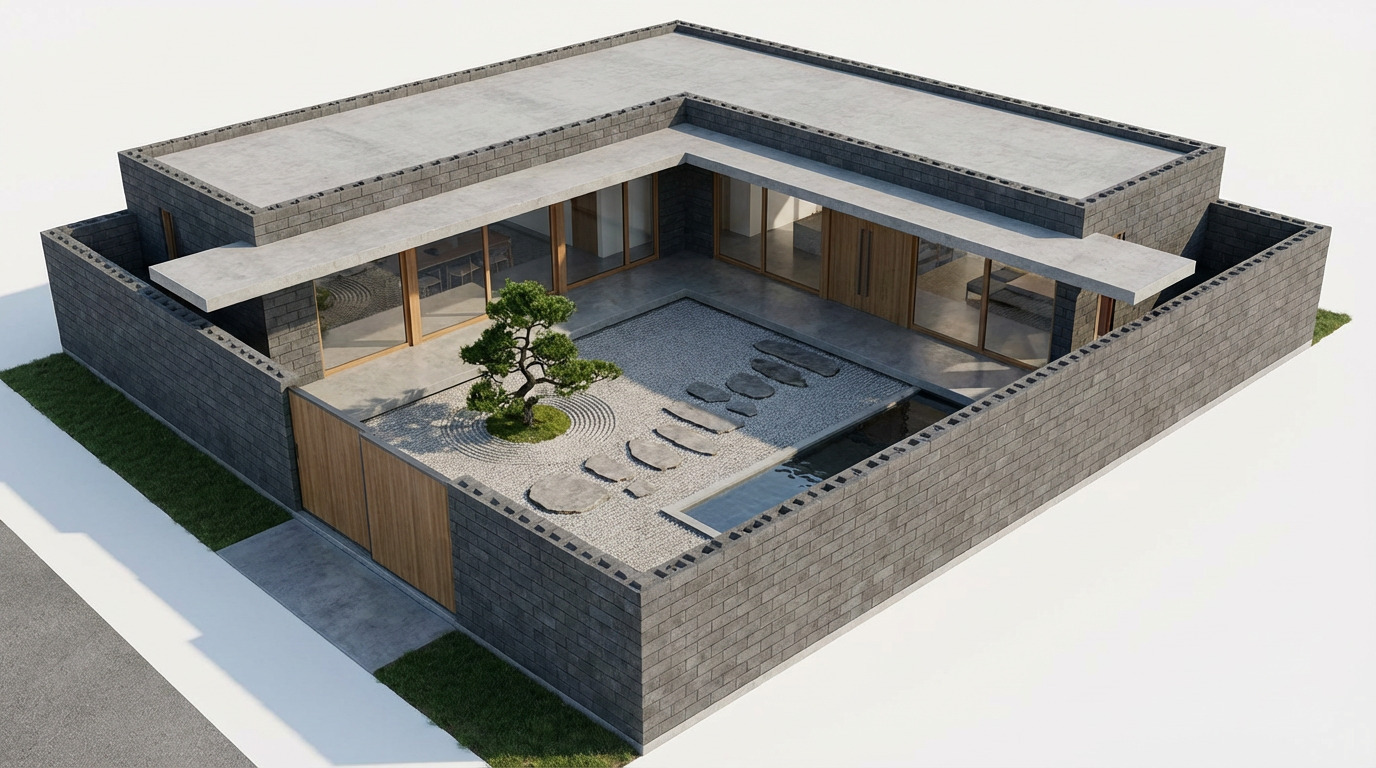
L-Shaped Courtyard
Key Features
- Zen garden integration
- Floor-to-ceiling glass walls
- Minimalist single-story design
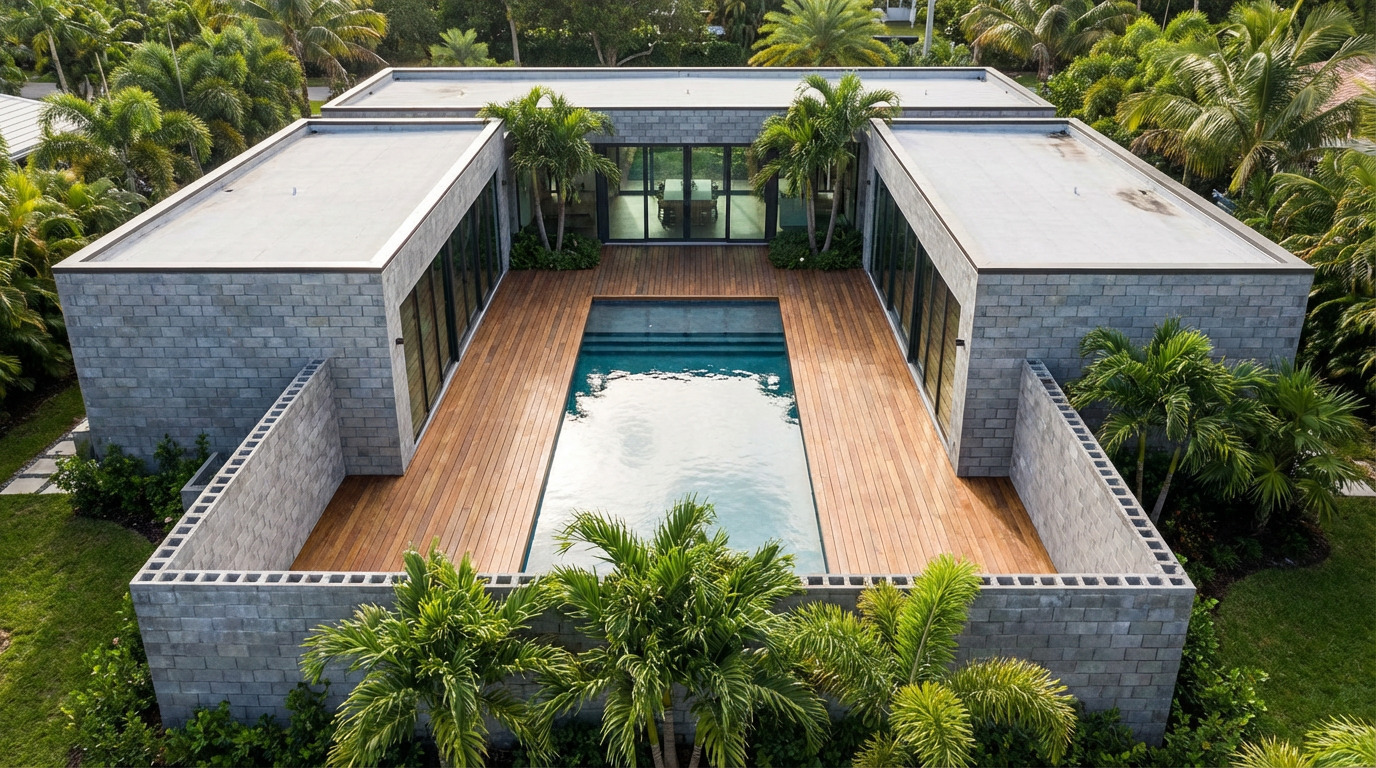
U-Shaped Pool Courtyard
Key Features
- Central pool feature
- Expansive wooden deck
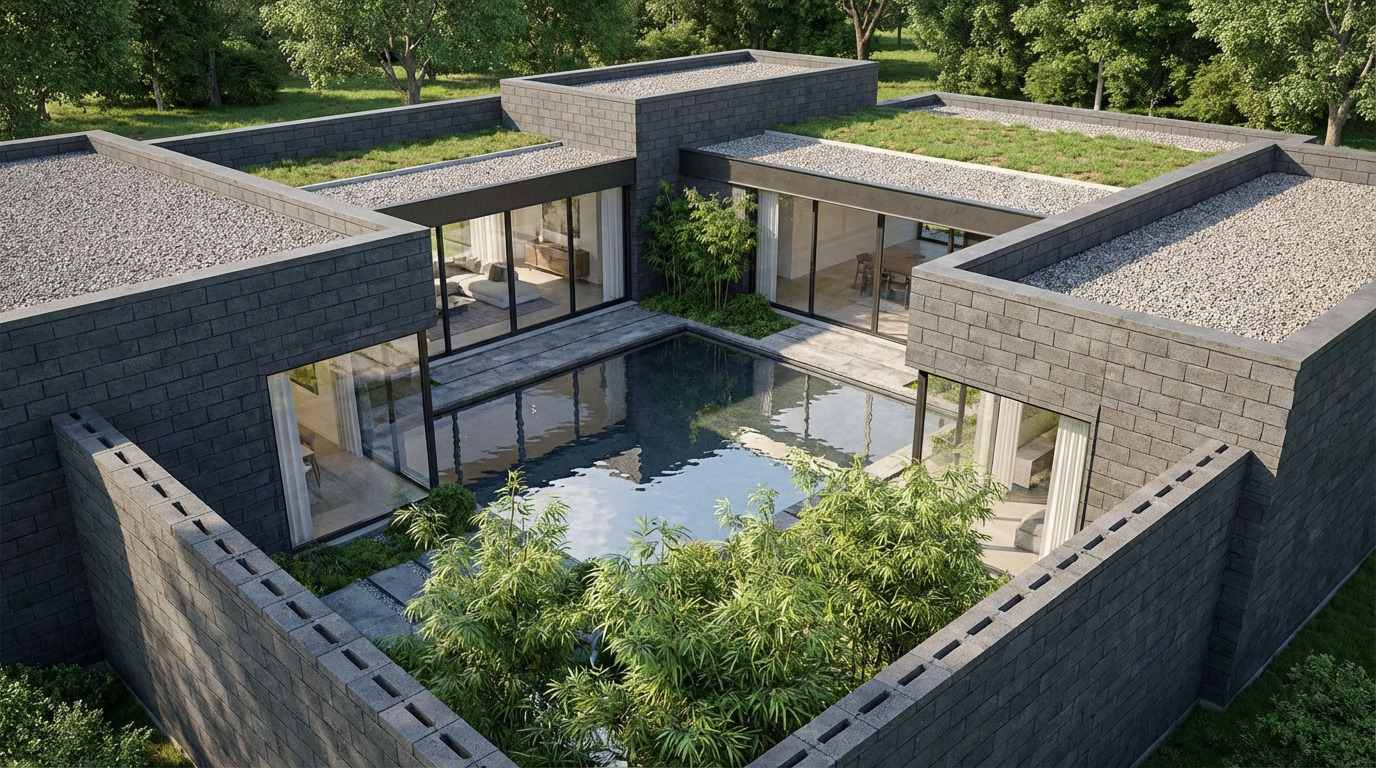
Square Atrium Courtyard
Key Features
- Reflecting pool
- Stone pathways
- Bamboo garden
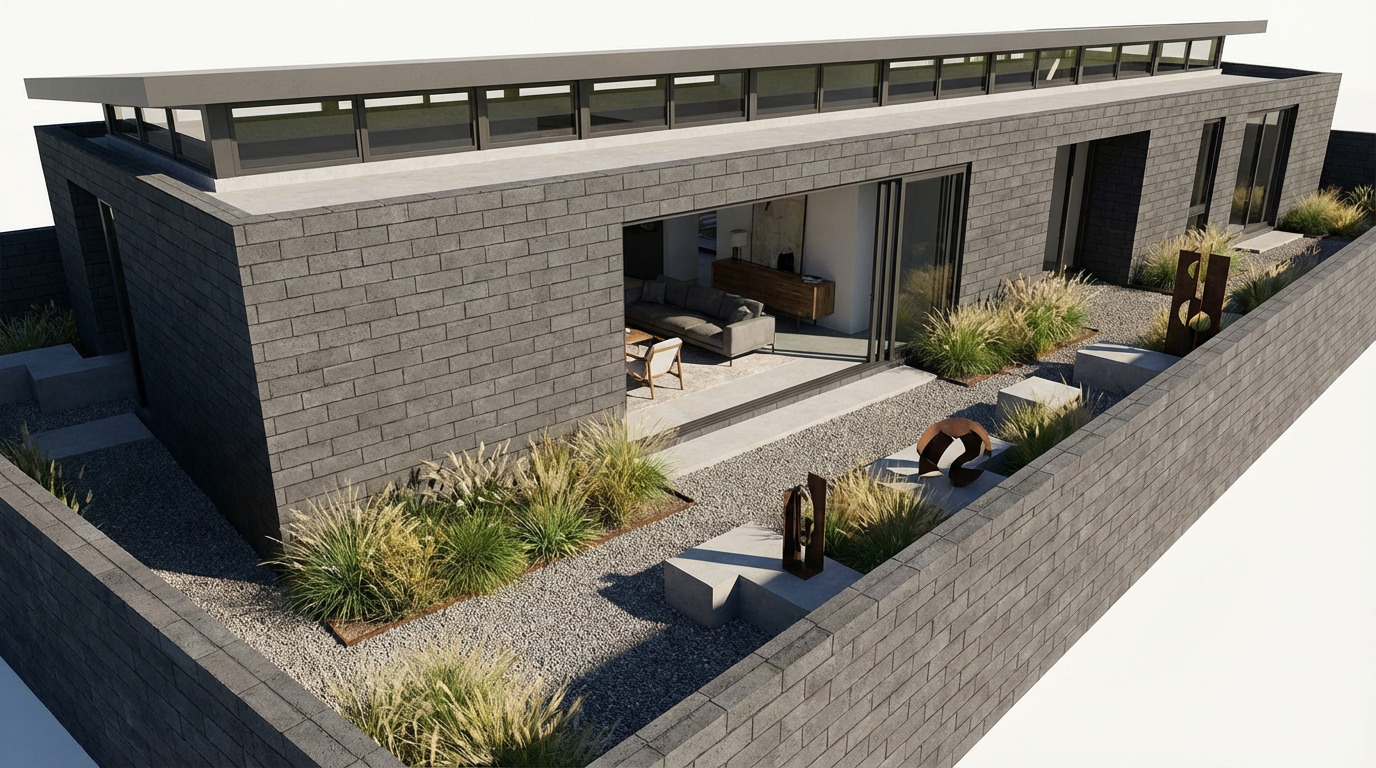
Linear Side Courtyard
Key Features
- Private courtyard
- Native grass landscaping
- Sculptural elements
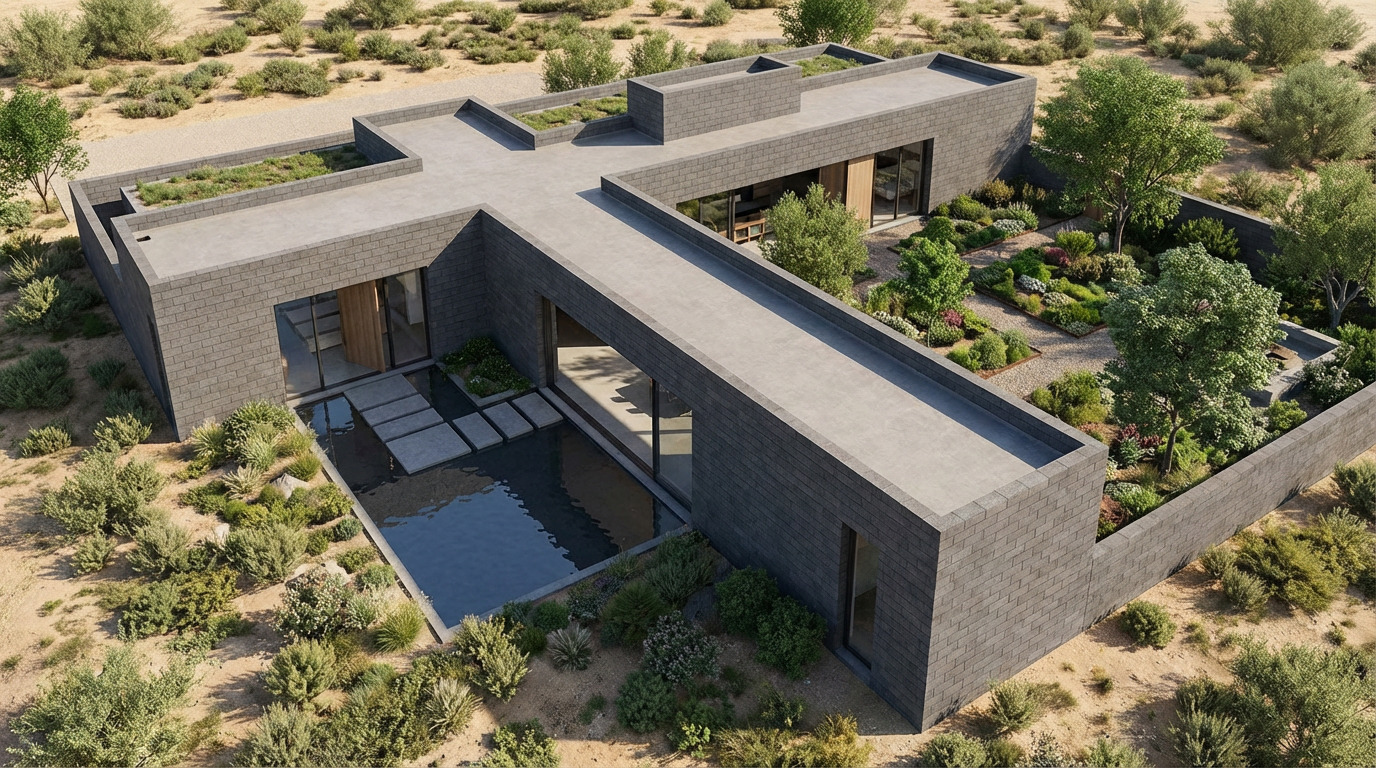
T-Shaped Dual Courtyard
Key Features
- Water feature courtyard
- Separate garden courtyard
- Varying roof heights
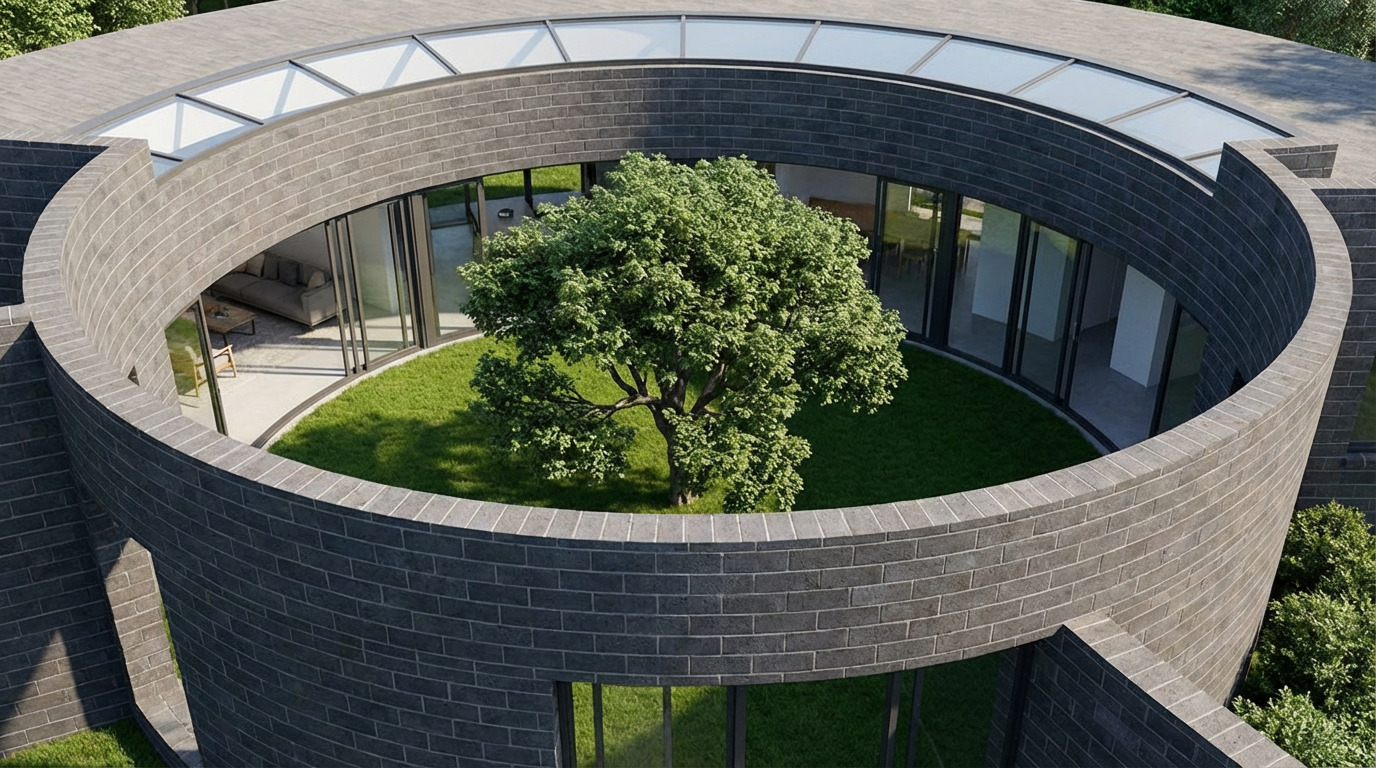
Circular Courtyard
Key Features
- Central tree focal point
- Circular lawn
- Skylight ring design
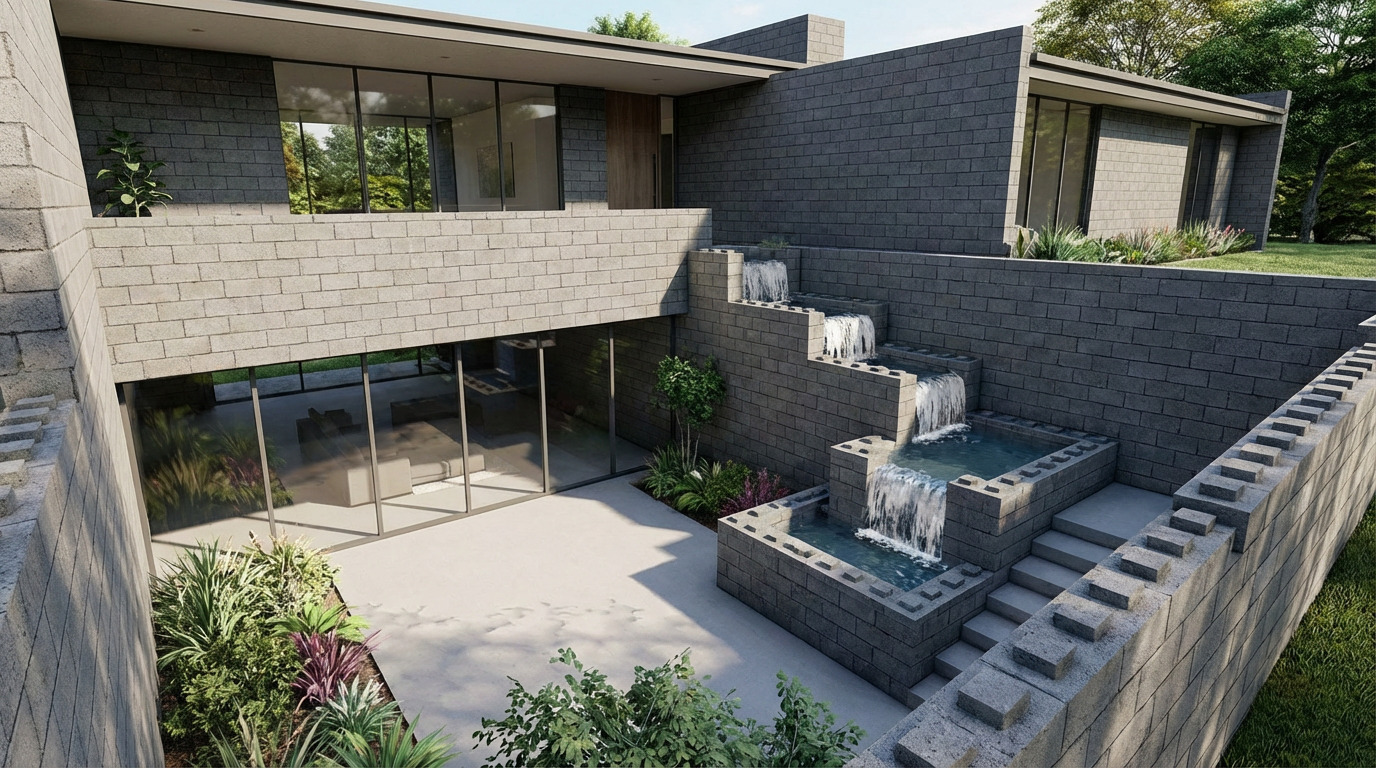
Split-Level Sunken
Key Features
- Sunken courtyard design
- Water cascade feature
- Terraced levels
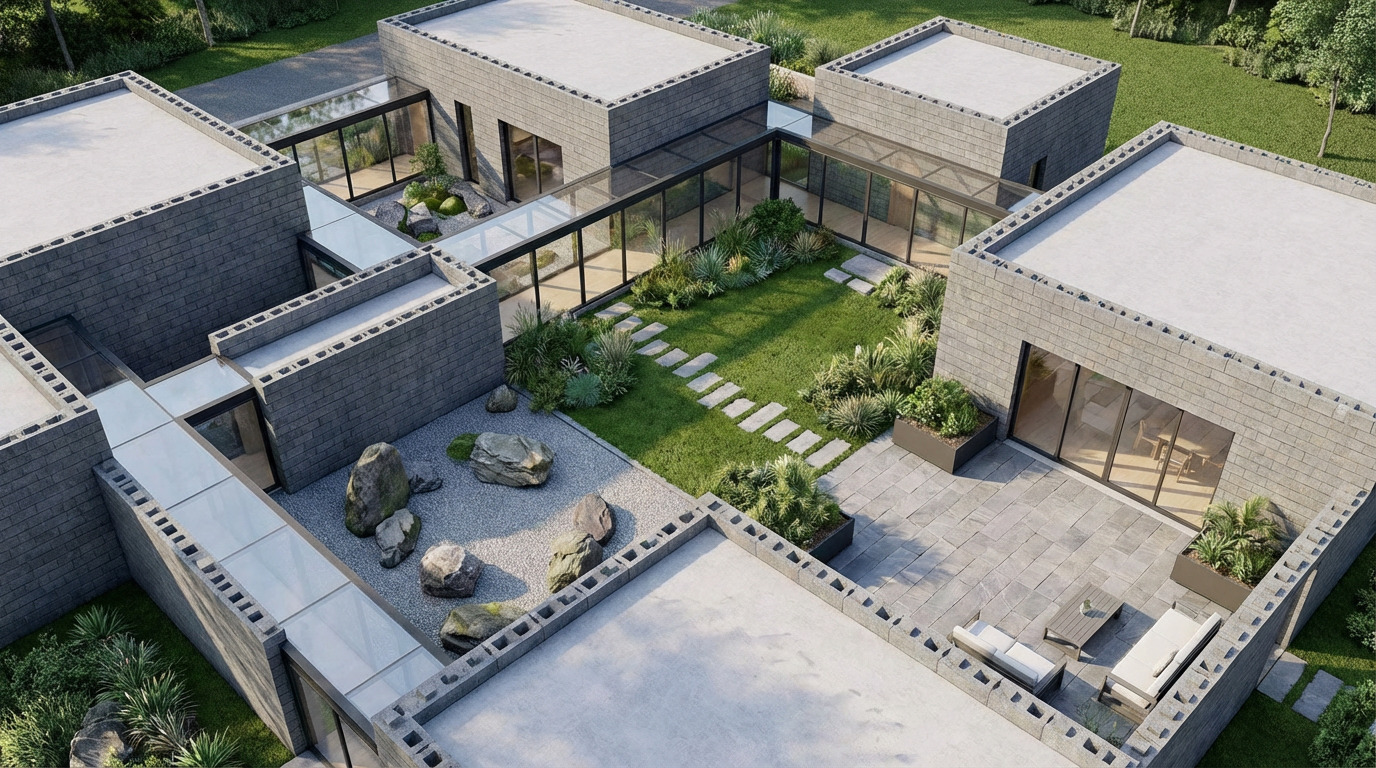
Cluster Multiple Courtyards
Key Features
- Three themed courtyards
- Pavilion style architecture
- Rock, grass, and paved zones
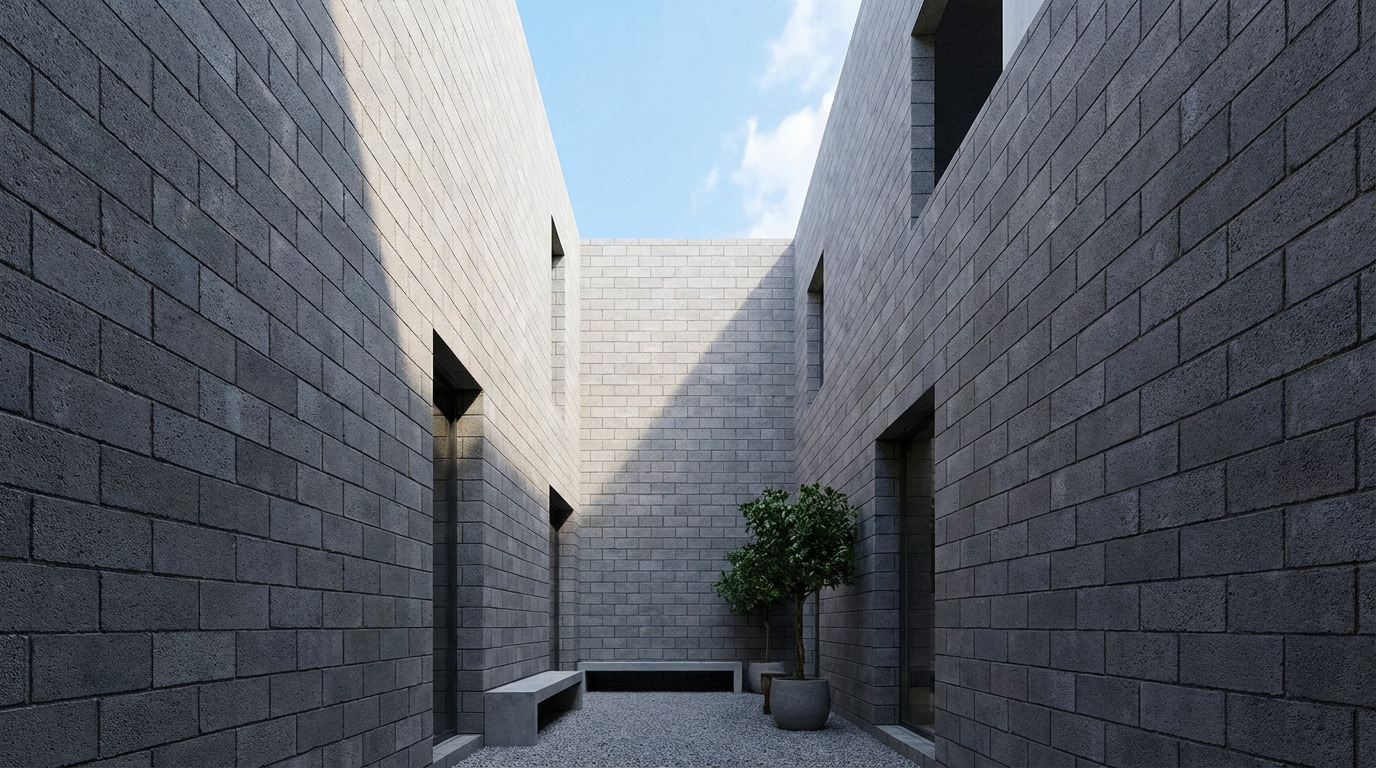
Minimalist Void Courtyard
Key Features
- Dramatic tall walls
- Open sky concept
- Minimalist furnishings
Assembly Methods & Automation Options
The interlocking brick system supports various assembly methods ranging from traditional manual labor to cutting-edge automation. Each method offers unique advantages in terms of speed, precision, cost, and scalability.
Manual Assembly (People)
Traditional construction method utilizing skilled and semi-skilled labor for brick placement and assembly.
ADVANTAGES:
- ✓ Low initial investment
- ✓ Flexible and adaptable to site conditions
- ✓ Readily available workforce
- ✓ Handles irregular layouts easily
- ✓ Minimal equipment requirements
CONSIDERATIONS:
- • Slower than automated methods
- • Quality depends on worker skill
- • Labor availability constraints
- • Weather dependent
Typical Speed: 50-80 bricks per worker per day
Best For: Small projects, custom work, irregular sites
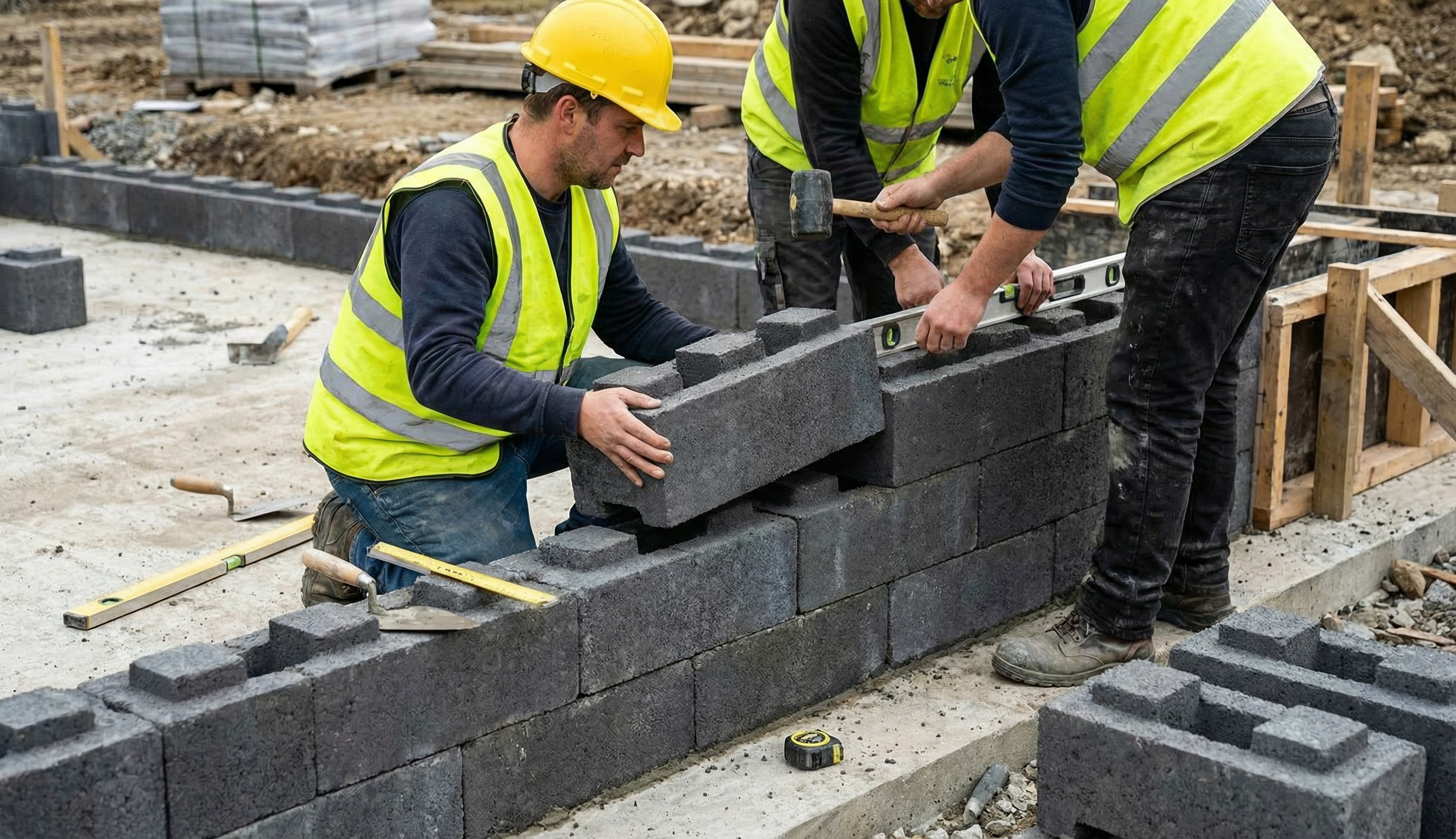
Manual brick assembly by skilled construction workers
Pulley & Hoist Systems
Mechanical assistance using block and tackle, chain hoists, or electric winches to lift and position heavy brick units at height.
ADVANTAGES:
- ✓ Reduces physical strain on workers
- ✓ Enables vertical construction efficiently
- ✓ Moderate equipment cost
- ✓ Portable and relocatable
- ✓ Increases productivity 40-60%
CONSIDERATIONS:
- • Requires stable support structure
- • Still requires manual positioning
- • Load capacity limitations
- • Safety protocols essential
Typical Speed: 80-120 bricks per crew per day
Best For: Multi-story construction, heavy units, remote locations
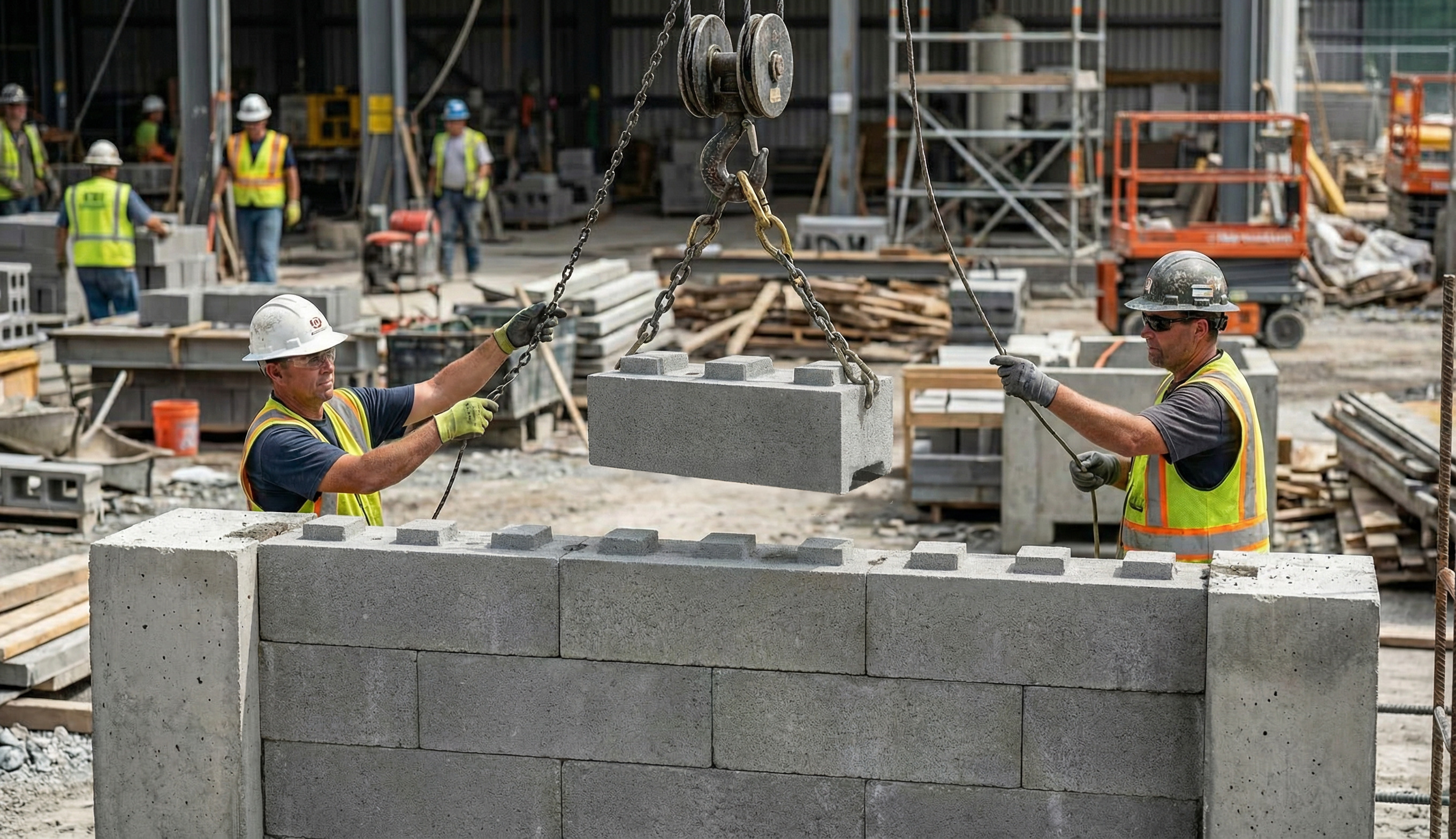
Pulley and hoist systems for vertical material transport
Gantry Crane Systems
Overhead bridge crane system with programmable movements for precise brick positioning across the entire construction site.
ADVANTAGES:
- ✓ High precision placement (±2mm)
- ✓ Large coverage area
- ✓ Handles multiple tons capacity
- ✓ Weather-protected operations
- ✓ Increases speed by 100-200%
- ✓ Reduces labor requirements
CONSIDERATIONS:
- • High initial investment ($50K-200K)
- • Requires permanent structure
- • Limited to gantry footprint
- • Setup time required
Typical Speed: 150-250 bricks per shift
Best For: Large-scale projects, repetitive construction, controlled environment
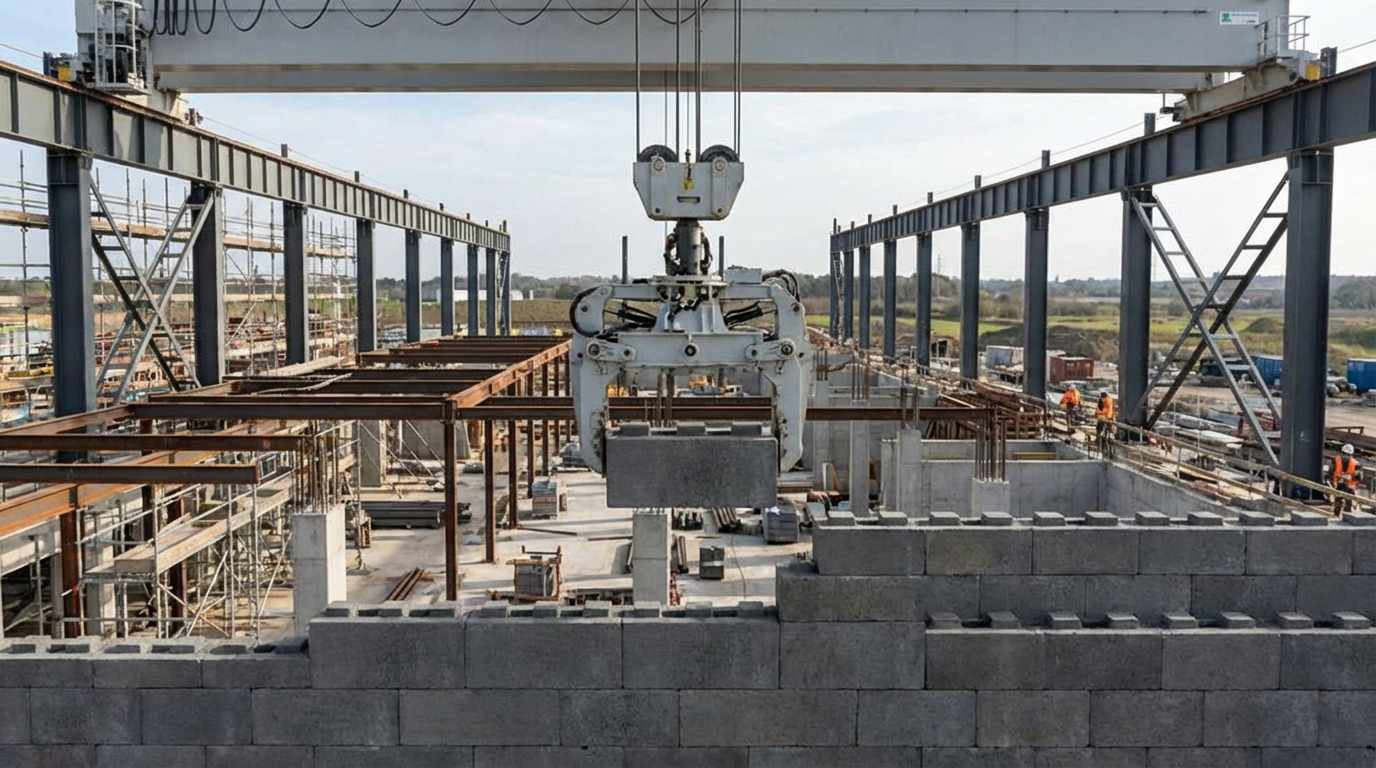
Gantry crane system for precise overhead material handling
Industrial Robotic Arms
Fixed or mobile robotic arm systems with 6+ axis movement, vision systems, and precision grippers for automated brick placement.
ADVANTAGES:
- ✓ 24/7 autonomous operation
- ✓ Programmable patterns
- ✓ Integration with BIM/CAD
- ✓ Speed increase 300-500%
- ✓ Minimal human error
CONSIDERATIONS:
- • Very high cost ($200K-1M+)
- • Requires skilled programming
- • Limited reach radius
- • Maintenance expertise needed
- • Site preparation critical
Typical Speed: 300-500 bricks per shift
Best For: Mass production, factory prefabrication, high-precision work
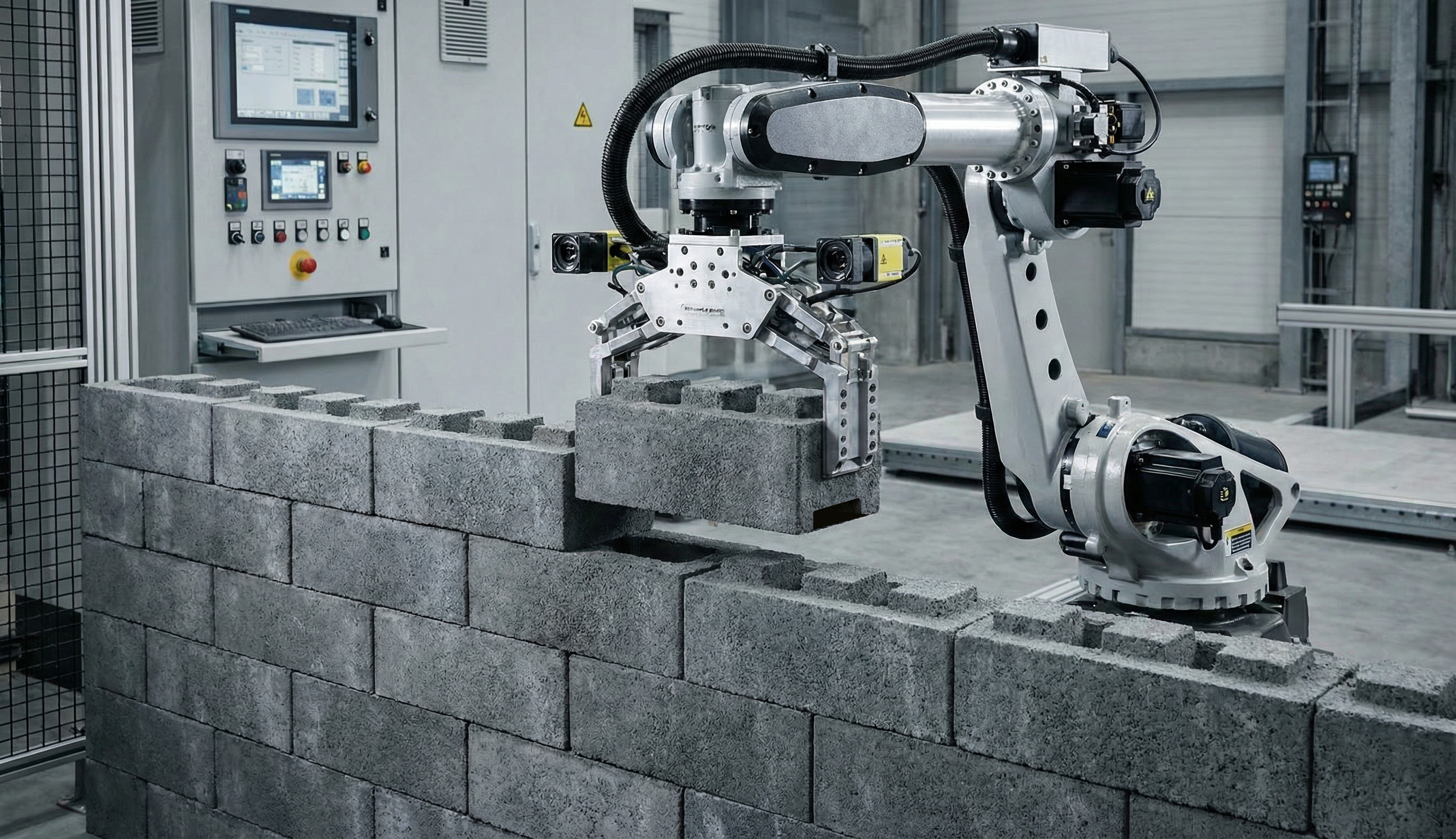
Industrial robotic arm with precision gripper for automated assembly
Humanoid Robots
Next-generation bipedal robots designed to work alongside humans, mimicking human movements and using standard tools in construction environments.
ADVANTAGES:
- ✓ Human-like dexterity and mobility
- ✓ Navigates existing infrastructure
- ✓ Uses standard tools and equipment
- ✓ AI learning and adaptation
- ✓ Operates in human spaces safely
- ✓ Collaborative with human workers
CONSIDERATIONS:
- • Cutting-edge technology (emerging)
- • Extremely high cost ($500K-2M+)
- • Battery life limitations
- • Regulatory frameworks developing
- • Slower than fixed robotics
Typical Speed: 100-200 bricks per shift (improving rapidly)
Best For: Future construction, hazardous sites, labor shortages
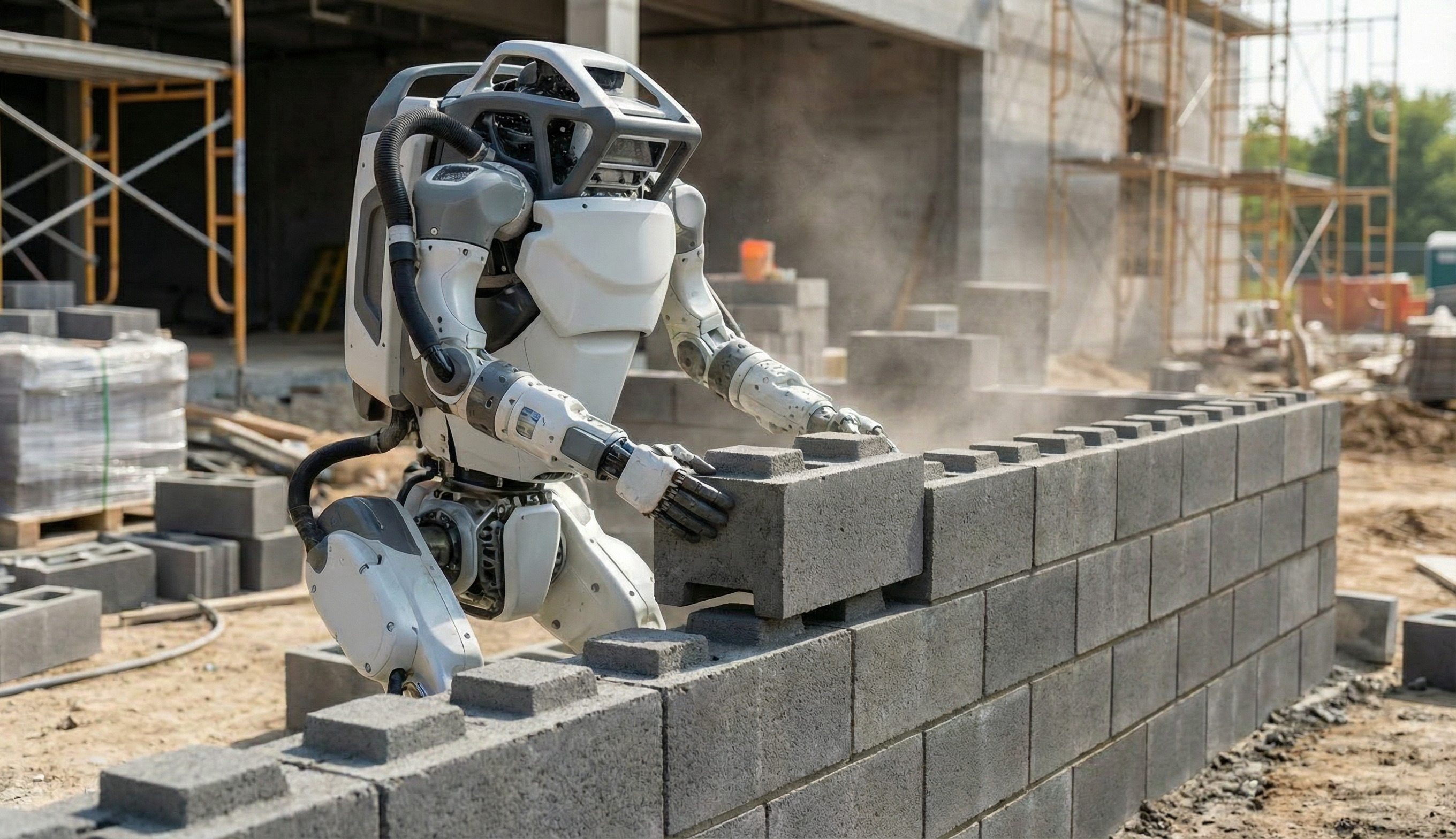
Next-generation humanoid robot for construction applications
Method Selection Guide
SMALL PROJECTS (< 1,000 bricks)
Recommended: Manual
Labor or Pulley Systems
Cost-effective, flexible, sufficient speed.
MEDIUM PROJECTS (1,000-5,000 bricks)
Recommended: Gantry
Systems or Pulley + Manual
Balance of speed, precision, cost.
LARGE PROJECTS (> 5,000 bricks)
Recommended: Robotic
Arms or Gantry Systems
Maximum efficiency, ROI justified.
3.0 Calculations & Data
Formula:
Linear Wall: 0.5 bricks/ft | Vertical: 0.5 courses/ft
Example (House 01): 180ft x 0.5 = 90 bricks/course. 10ft height = 5 courses. 90×5 = 450 (one side) x 2 = 900 bricks.
| House Design | Bricks | Wall Length | Height | Foundation |
|---|---|---|---|---|
| 01 L-Shaped | 900 | 180 ft | 10 ft | 2,400 sf |
| 02 U-Shaped | 1,650 | 220 ft | 10-20 ft | 3,200 sf |
| 03 Square Atrium | 1,100 | 200 ft | 10 ft | 2,800 sf |
| 04 Linear Side | 1,200 | 240 ft | 10 ft | 2,600 sf |
| 05 T-Shaped | 1,350 | 210 ft | 10-15 ft | 3,000 sf |
| 06 Circular | 1,050 | 190 ft | 10 ft | 2,500 sf |
| 07 Split-Level | 1,450 | 230 ft | 8-14 ft | 3,100 sf |
| 08 Cluster | 1,250 | 250 ft | 10 ft | 2,900 sf |
| 09 Minimalist | 960 | 160 ft | 12 ft | 2,200 sf |
| 10 Compound | 1,400 | 280 ft | 10 ft | 3,400 sf |
| TOTALS | 12,310 | 2,160 ft | – | 28,100 sf |
Cost & Advantages
Cost Estimation (House 01)
Structural
High strength, earthquake resistant, no mortar required, modular expansion.
Construction
30-40% faster, less skilled labor, reduced waste, standard quality control.
Maintenance
- Annual: Check cracks, sealant, drainage.
- 5-Year: Re-apply waterproofing, structural check.
- Long-term: 10-year pro assessment.
Compliance
- Must meet local building codes (IBC/IRC).
- Requires Structural Engineer certification.
- Permits: Building, Foundation, MEP.